kamadinfratech.in

Installation Guide

Three tested ways to build a breeze block wall — and how to decide which one your site needs.

A breeze block wall is not difficult to build, but the three methods below suit very different situations, and picking the wrong one is what causes a screen to look bowed two years later.

Read this before your mason starts. If your wall is over 8 ft, or the public can lean on it, skip straight to method two.

01

Laid like brickwork

Exactly like laying bricks — cement mortar or tile adhesive, stacked one on another. This is how most boundary screens and short walls go up, and it needs no special skill beyond a straight line and a spirit level.

Best for: screens up to about 8 ft, boundary walls, planter walls.
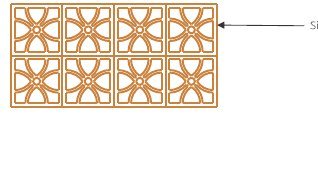
Laid like brickwork
02

With intermediate stiffeners

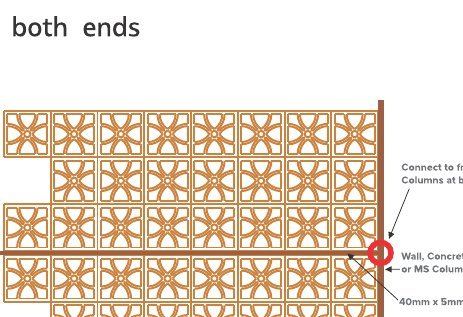
The same method with steel stiffeners added. A jali wall carries its own weight easily, but if someone leans on it or the wind pushes, the lateral force has to go somewhere. A 40 mm × 5 mm MS plate every 3 or 4 courses, connected at both ends to a column or MS support, takes that load.

Best for: tall screens, long spans, anywhere the public can touch the wall.

With intermediate stiffeners
03

Mechanical grid system

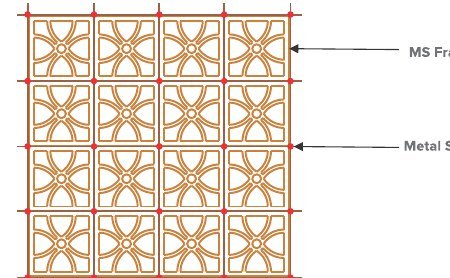
A purely mechanical method. Build a 200 × 200 mm MS grid and drop each block into its cell with metal stoppers holding it. Leave tolerance for the small size variation that all cast products have. No mortar shows at all.

Best for: facades, double-height screens, and anywhere the jali may need to come out later.

Mechanical grid system
Finishing

Details that decide how it looks in year five

Painting

Breeze blocks take any exterior paint. Use a primer first — the finish comes out even and the coat lasts far longer.

Joint width

A 3 mm or 4 mm groove between blocks reads crisply. With adhesive you can go down to a 1 mm line for a near-seamless wall.

Cleaning

Wash with drinking or RO water. Hard bore water leaves salt marks on the face. A mild detergent once or twice a year is enough.

Curing

Blocks arrive cured. Keep them dry and stacked on pallets on site — direct ground contact stains the bottom course.

Tolerance

Cast products vary by a millimetre or two. Set out from the centre of the wall so any adjustment lands at the ends, not in the middle.

Sequence

Fix stiffeners as you go up, not afterwards. Retrofitting them into a finished screen means dismantling courses.

Product features

What you get with every block

Natural sunlight
Natural ventilation
Easy installation
Low maintenance
All weather resistance
Fungus free
Design flexibility
100% asbestos free
Termite free
Fire resistance
Cost and time saving
20 year durability
Next step

Send the drawing. Get a quote with a date on it.

A rough quantity and a pin code is enough to start. Most quotations go out within one working day.

  • Samples couriered before you commit
  • Freight quoted separately and honestly
  • Test reports available with any order

+91 77 37 37 39 11

WhatsApp instead

We use your details only to answer this enquiry.