By a Rajasthani Builder & Site Engineer | Reading Time: 7 Mins
Introduction: The Age-Old Question on Every Site
Namaste! If you are planning a new project—whether it is an independent villa in Bhilwara, a commercial complex in Jaipur, or an industrial warehouse in Jodhpur—one critical decision comes right at the foundation stage:
“Wall masonry ke liye kya best rahega: Traditional Red Clay Bricks ya Modern Cement Concrete Blocks?”
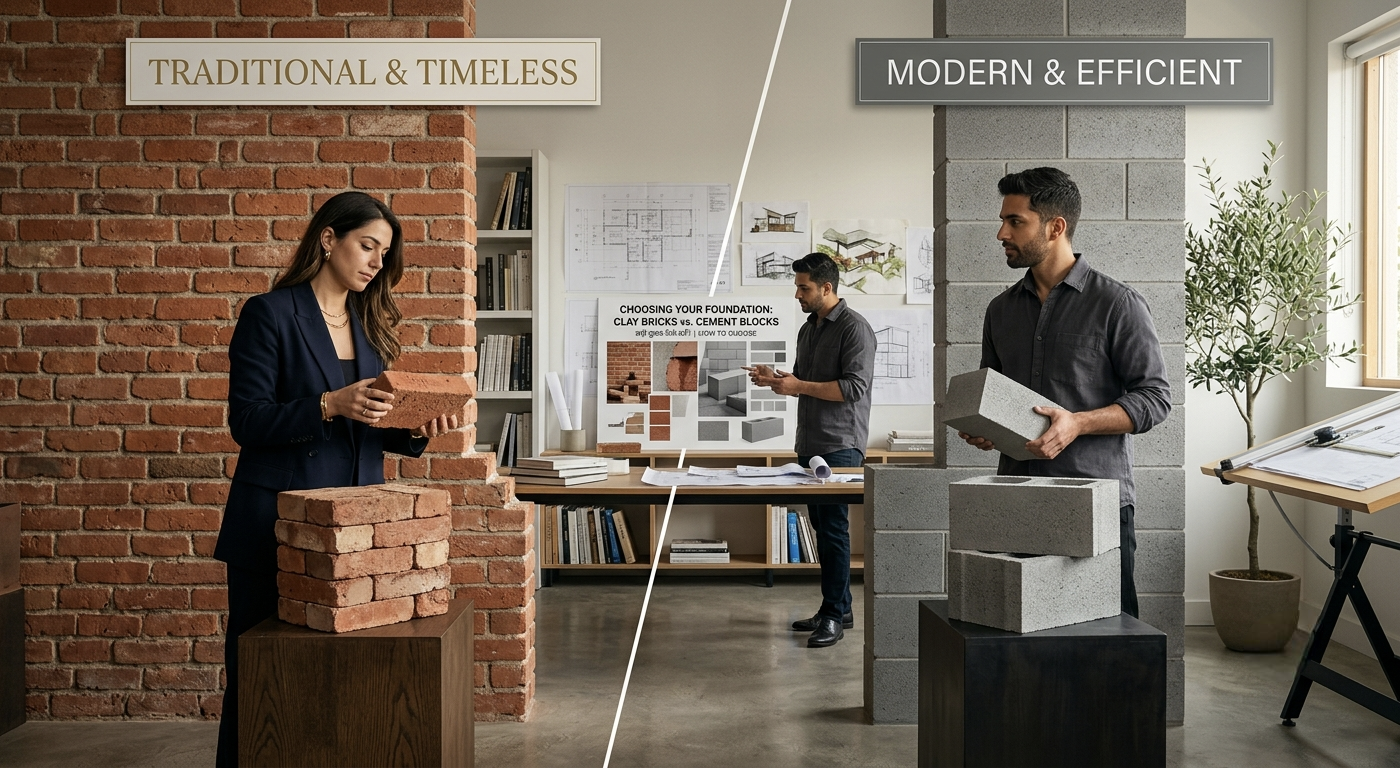
For decades in India, red clay bricks have been the default choice. But with rapid changes in RCC frame construction, soaring sand and labor costs, and the harsh climate of North and Western India, cement blocks have emerged as the smarter, technically advanced, and cost-effective alternative.
In this complete technical guide, we break down both materials honestly—where to use what, their real-world site performance, and why precision-made cement blocks are steadily overtaking traditional clay bricks.
1. Understanding the Materials: What Are You Really Buying?
A. Red Clay Bricks (The Traditional Heritage Material)
Clay bricks are made from topsoil (alluvial or red clay), sun-dried, and fired in traditional kilns (bhatta).
- Strength & Look: Solid, heavy, with a naturally rich, rustic terracotta tone.
- The Reality Check on Ground: In today’s market, finding consistent Class-A kiln bricks is tough. Variations in size, uneven baking, high soil salinity, and edge chipping lead to crooked walls and thick plastering.
B. Cement Concrete Blocks (The Modern Engineered Alternative)
Cement blocks (available as Solid Concrete Blocks, Hollow Concrete Blocks, and High-Density Paving/Masonry units) are
machine-folded
using Portland cement, graded stone aggregate/quarry dust, and water, followed by scientific water curing.
- Strength & Look: Factory-calibrated, razor-sharp edges, uniform dimensions, and tested load-bearing capacity.
- The Site Reality: Every single piece is uniform. You get straight joint lines, structural consistency, and minimum mortar wastage.
2. Head-to-Head Comparison: Clay Bricks vs. Cement Blocks
Here is a side-by-side technical breakdown tailored for Indian site conditions:
| Parameter | Traditional Clay Bricks | Modern Cement Concrete Blocks | The Engineer’s Verdict |
|---|---|---|---|
| Dimensional Accuracy | Irregular (±5mm to 10mm variation) | Factory uniform (±1mm to 2mm) | Cement Blocks win: Flat walls, no plaster bulges. |
| Mortar Consumption | High (due to irregular joints) | 40% to 50% less mortar required | Cement Blocks win: Huge saving on cement & river sand. |
| Plaster Thickness Needed | 15mm – 25mm to hide undulations | 8mm – 12mm thin coat is sufficient | Cement Blocks win: Drastic cut in overall material cost. |
| Construction Speed | Slower (small unit size) | 2.5x to 3x faster wall laying | Cement Blocks win: Massive labor savings. |
| Dry Density / Dead Load | ~1800 to 2000 kg/m³ (Heavy) | Hollow: ~1100–1400 kg/m³ / Solid: ~1800 kg/m³ | Cement Blocks win: Hollow blocks reduce beam-column load. |
| Salt Attack & Efflorescence (Shor/Khaari) | Very high risk if soil/water has salt | Zero efflorescence with quality cement/curing | Cement Blocks win: No paint peeling or wall dampness. |
| Thermal Performance in Rajasthan | Good natural thermal mass | Excellent (especially hollow blocks with air cavities) | Cement Blocks match/exceed: Air pockets act as heat barrier. |
| Environmental Impact | Depletes agricultural topsoil | Uses quarry byproducts; eco-compliant | Cement Blocks win: Sustainable and green building rated. |
3. Why Cement Blocks Are Clearly Superior for Modern Construction
While clay bricks have nostalgia, here is why seasoned architects and structural engineers are shifting to factory-made cement blocks:
1. Significant Cost Reduction (Plaster & Mortar Savings)
Because clay bricks vary in shape, masons (mistris) have to apply thick 20mm+ plaster layers to get a plumb-straight wall. Cement blocks are machine-pressed. Their surfaces are straight and level. You save up to 50% mortar in jointing and require half the plaster thickness, saving lakhs on cement, M-sand, and labor.
2. No Efflorescence (Shora Problem Solved)
In many parts of Rajasthan and North India, ground clay contains high sulphate and salt levels. After a couple of monsoons, white powdery salt patches appear on brick walls, ruining expensive primer, putty, and paint. Factory-cured cement blocks use pure stone aggregate and standard PPC/OPC cement. They do not release free salts, keeping your interior paints and exterior textures fresh for years.
3. Hollow Blocks Keep Buildings Cooler
A common myth is that red brick is always cooler. In reality, hollow cement blocks feature engineered internal air cavities. Air is one of nature’s best insulators. The trapped air inside the hollow block breaks the continuous heat transfer from outside to inside. In harsh 45°C+ summer heat, hollow concrete block walls keep indoor temperatures significantly lower, reducing air conditioning electricity bills.
4. Reduced Dead Weight on RCC Frames
In modern multi-story buildings, walls are non-load bearing partitions. Using hollow cement blocks cuts wall dead-weight by nearly 30% to 40%. Lighter walls mean reduced stress on foundation footings, columns, and beams, which directly cuts down structural steel consumption.
5. Perfect for Chasing & Concealed Conduits
Electrical pipes and plumbing lines are easy to route inside the hollow cores of cement blocks without excessive hacking or weakening the main wall structure.
4. Where Should You Use Which? (Application Guide)
When Clay Bricks Make Sense:
- Exposed Brick Facades: When an architect specifically demands an unplastered, raw rustic red brick aesthetic for a heritage resort, cafe, or farmhouse elevation.
- Small Low-Rise Traditional Boundary Walls: Small local repair works where only 200-300 loose bricks are needed instantly from a nearby cart.
- Curved or Intricate Masonry: Very tight arches and circular columns where small unit sizes allow easier shaping by hand.
Where Cement Blocks Are the Absolute Best Choice:
- RCC Frame Buildings (Villas, Flats & Commercial): Hollow blocks provide the ideal mix of high speed, low dead load, and sharp plumb line finish.
- Boundary Walls & Compound Enclosures: Solid or hollow cement blocks cover large running lengths at unmatched speed with maximum strength.
- High-Moisture & Saline Zones: Basements, plinth levels, and areas prone to dampness where clay bricks deteriorate due to salt weathering.
- Acoustic & Sound Partition Walls: Offices, hospitals, and hotels where hollow cavity concrete blocks damp external street noise effectively.
5. Practical Site Tips from a Rajasthani Engineer
- Check for Proper Curing: When ordering cement blocks, ensure they are manufactured with hydraulic compaction and properly water-cured for at least 14 to 21 days to achieve full characteristic strength.
- Use Block Jointing Mortar: For fastest masonry and zero joint cracks, use polymer-modified thin-bed block jointing adhesive instead of thick conventional sand-cement mortar.
- Band Beams at Lintel Level: While building high partition walls with hollow blocks, cast a continuous thin RCC bond-beam (patli sill slab) at mid-height to prevent settlement hairline cracks.
The Final Verdict
Red clay bricks had their golden era, but modern architecture demands speed, structural precision, zero maintenance, and cost control.
High-quality cement concrete blocks deliver better compressive strength, eliminate the menace of efflorescence (shora), cut down construction time by half, and drastically reduce plastering expenses.
If you want a building that stands plumb, stays cool, and saves you money from day one of plastering, engineered cement blocks are the hands-down winner for your next project.
Looking for high-strength, machine-compacted cement blocks and premium building solutions tested for Indian weather conditions? Get in touch with our technical team for site estimates and samples.